
Dollar-Cost Averaging: The Simplest Strategy That Works
⚡ Key Takeaways
- Dollar-cost averaging (DCA) means investing a fixed dollar amount at regular intervals regardless of market price
- DCA automatically buys more shares when prices are low and fewer shares when prices are high
- Lump sum investing beats DCA about two-thirds of the time historically, but DCA reduces regret risk and emotional stress
- DCA eliminates the need to time the market, making it ideal for most long-term investors
- Most people already DCA through automatic 401(k) contributions from each paycheck
What Is Dollar-Cost Averaging?
Dollar-cost averaging (DCA) is an investment strategy where you invest a fixed dollar amount at regular intervals — typically weekly, biweekly, or monthly — regardless of whether the market is up, down, or sideways. Instead of trying to time the market by buying when prices are low, you buy consistently and let the math work in your favor.
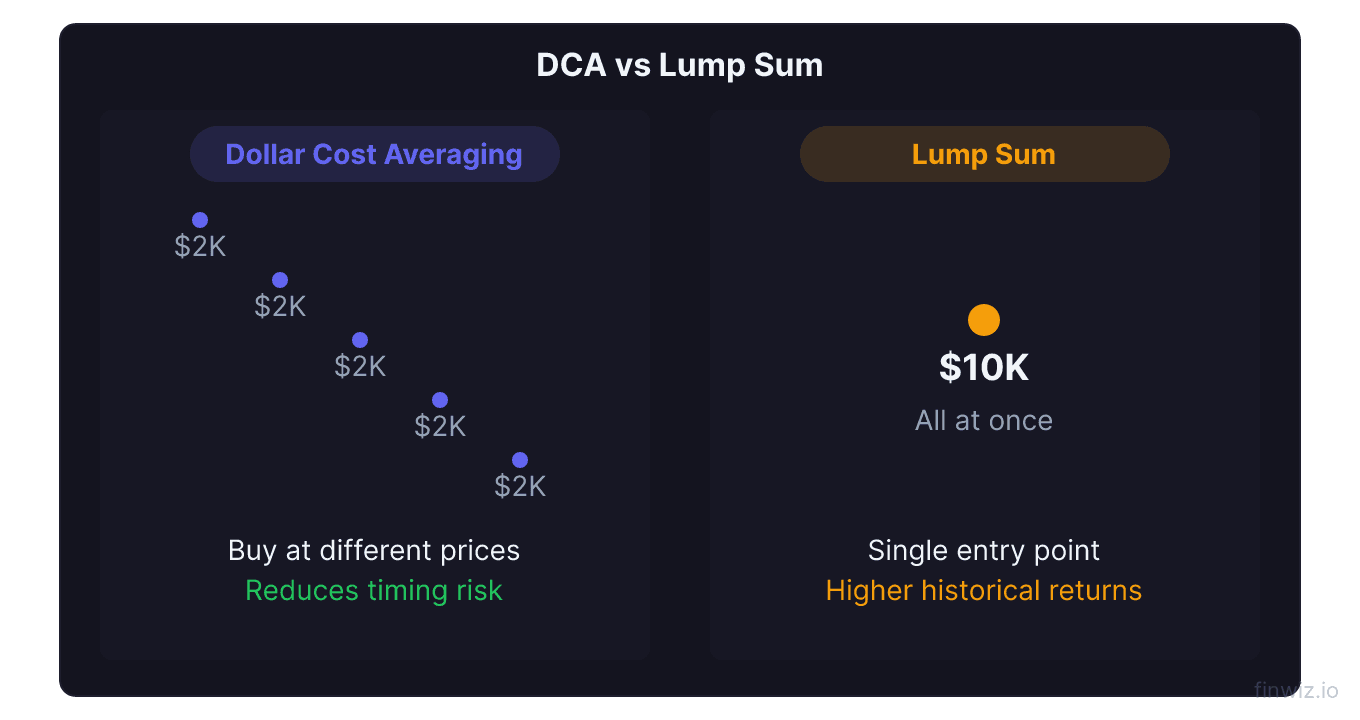
The strategy is elegantly simple. You invest $500 every month into an index fund. Some months the fund is expensive, so you buy fewer shares. Other months it is cheaper, so you buy more shares. Over time, this results in an average cost per share that is lower than the average price per share during the same period.
DCA is already the default strategy for millions of Americans through their 401(k) contributions. Every paycheck, a fixed amount goes into your retirement account and buys whatever you can at that day's price. You are dollar-cost averaging without even thinking about it.
The power of DCA lies in its simplicity and consistency. It removes emotion from investing, eliminates the anxiety of market timing, and builds wealth steadily through good markets and bad.
How Dollar-Cost Averaging Works
Let's trace a DCA strategy through a volatile 6-month period to see the mechanics in action.
You invest $500 per month in Fund XYZ:
| Month | Share Price | Shares Purchased | Total Invested | Total Shares |
|---|---|---|---|---|
| January | $50.00 | 10.00 | $500 | 10.00 |
| February | $45.00 | 11.11 | $1,000 | 21.11 |
| March | $40.00 | 12.50 | $1,500 | 33.61 |
| April | $42.00 | 11.90 | $2,000 | 45.51 |
| May | $48.00 | 10.42 | $2,500 | 55.93 |
| June | $50.00 | 10.00 | $3,000 | 65.93 |
The math:
- Total invested: $3,000
- Total shares owned: 65.93
- Average cost per share: $3,000 / 65.93 = $45.50
- Average price over the period: ($50 + $45 + $40 + $42 + $48 + $50) / 6 = $45.83
Average Cost Per Share = Total Dollars Invested / Total Shares Purchased = $3,000 / 65.93 = $45.50Your average cost ($45.50) is lower than the average market price ($45.83). This happens because you automatically bought more shares at the lower prices in February, March, and April. The strategy mathematically favors buying at lower prices without requiring you to predict when those low prices will occur.
At the end of June, with shares at $50, your portfolio is worth $50 x 65.93 = $3,296.50, a gain of $296.50 or 9.9% — even though the share price ended exactly where it started.
The Mathematical Advantage of DCA
The reason DCA produces a lower average cost than the average price is a mathematical property called the harmonic mean. When you invest fixed dollar amounts, you naturally buy a quantity that is inversely proportional to the price.
DCA Average Cost = n / (1/P1 + 1/P2 + ... + 1/Pn), where n = number of periods and P = price in each periodThe harmonic mean is always less than or equal to the arithmetic mean (the simple average). This means DCA's average cost is mathematically guaranteed to be at or below the average market price over the same period, as long as prices vary.
The bigger the price swings, the larger the advantage. In a market that fluctuates wildly, DCA buys significantly more shares at the lows, pulling the average cost down further below the average price.
However, this mathematical advantage does not mean DCA always beats lump sum investing. The advantage is in the cost basis relative to prices, not necessarily in total returns.
Pro Tip
DCA vs Lump Sum Investing
The debate between dollar-cost averaging and lump sum investing (investing all your money at once) is one of the most studied questions in finance.
What research shows:
A landmark Vanguard study analyzed rolling periods from 1926-2011 and found that lump sum investing outperformed DCA approximately 68% of the time across U.S., UK, and Australian markets. The average outperformance was about 2.3% over a 12-month DCA period.
Why lump sum wins more often:
Markets go up more than they go down. Since stocks have a long-term upward bias, money invested earlier has more time to grow. When you DCA, the money waiting to be invested sits in cash, earning little to nothing, while the market (on average) rises.
Why DCA is still the right choice for many:
| Factor | Lump Sum | DCA |
|---|---|---|
| Historical win rate | ~68% | ~32% |
| Average performance | Higher | Lower |
| Worst-case scenario | Much worse (invest before crash) | Better protected |
| Emotional impact | High anxiety | Low anxiety |
| Regret potential | High (if market drops) | Low |
| Practical reality | Most people don't have a lump sum | Matches paycheck timing |
The 32% of the time lump sum loses, it can lose badly. Investing a lump sum right before a market crash results in much worse outcomes than DCA. For most investors, the emotional and behavioral benefits of DCA outweigh the average return advantage of lump sum.
Most importantly, most people do not have a lump sum. They earn money through paychecks and invest it as it comes in. For these investors, DCA is not a choice — it is the natural consequence of earning income over time.
How to Implement Dollar-Cost Averaging
Setting up a DCA strategy is straightforward. Here is the step-by-step process.
Step 1: Choose your investment amount. Decide how much you can invest each period. This should be an amount you can commit to consistently for at least 12 months. Even $100/month is meaningful over time.
Step 2: Choose your interval. Monthly is the most common. Biweekly works well if aligned with paychecks. Weekly is fine if you prefer smaller, more frequent purchases.
Step 3: Choose your investments. Broad market index funds are the ideal vehicle for DCA. They provide instant diversification, low costs, and exposure to the entire market.
Step 4: Automate it. Set up automatic recurring investments through your broker or 401(k). Automation removes the temptation to skip a month or try to time the market.
Step 5: Do not stop during downturns. The most important rule is to keep investing during market declines. These are the months when DCA shines — you are buying more shares at cheaper prices. Stopping DCA during a crash eliminates the strategy's primary benefit.
| DCA Schedule | Monthly Amount | Annual Investment | Suited For |
|---|---|---|---|
| Monthly | $500 | $6,000 | Most investors |
| Biweekly | $250 | $6,500 | Paycheck alignment |
| Weekly | $125 | $6,500 | Active investors |
| Monthly | $583 | $7,000 | Roth IRA max |
DCA During Market Crashes
The true power of DCA reveals itself during market downturns. While crashes are painful, they are exactly when DCA creates the most value.
Consider DCA through the 2008-2009 financial crisis. An investor putting $500/month into an S&P 500 index fund:
| Period | Market Action | DCA Investor Experience |
|---|---|---|
| Oct-Nov 2008 | S&P drops 30% | Buying shares at 30% discount |
| Feb-Mar 2009 | S&P hits bottom (50%+ from peak) | Buying at half price |
| Apr-Dec 2009 | Market recovers 60% from bottom | Shares bought at bottom soar in value |
| 2010-2012 | Full recovery | DCA investor's total return exceeds pre-crash level |
An investor who DCA'd $500/month from January 2007 through December 2012 invested a total of $36,000. By the end of 2012, that portfolio was worth approximately $49,000 — a 36% total return despite enduring the worst crash since the Great Depression. The shares purchased at deeply discounted prices in 2008-2009 became the most profitable shares in the entire portfolio.
This is why continuing to invest during downturns is the most critical element of DCA. Every dollar invested at the bottom has outsized returns during the recovery.
DCA and Behavioral Finance
One of the most underrated benefits of DCA is how it addresses the behavioral and psychological challenges of investing.
Loss aversion. Humans feel losses roughly twice as intensely as gains of the same size. This makes us reluctant to invest large sums that might immediately decline. DCA reduces this anxiety because you are only putting a small amount at risk at any given time.
Analysis paralysis. The fear of making a wrong decision can lead to not investing at all. Waiting for the "right time" to invest is one of the most common and costly mistakes. DCA eliminates this paralysis by removing the decision: you invest every month, period.
Regret minimization. If you invest a lump sum and the market drops 20% the next day, the regret is intense. DCA spreads purchases over time, so no single purchase can cause devastating regret.
Consistency. DCA builds the habit of investing regularly. Over decades, this habit is more important than any individual investment decision. Consistent investors who dollar-cost average into index funds build more wealth than brilliant investors who trade in and out.
The behavioral benefits alone make DCA the optimal strategy for most individual investors, even if lump sum investing has a slightly higher average return. The best strategy is the one you will actually follow consistently.
When DCA Is Not Ideal
While DCA is excellent for most situations, there are scenarios where other approaches may be better.
Received a large windfall. If you inherit $100,000 or receive a large bonus, research suggests investing the lump sum immediately will outperform DCA about two-thirds of the time. However, if investing the entire amount at once causes you significant anxiety, DCA it over 3-6 months. The psychological cost of stress may outweigh the statistical advantage of lump sum.
Very long DCA periods. Stretching DCA over 2-3 years means a lot of money sits in cash for a long time. If you are going to DCA a large sum, keep the period to 6-12 months maximum. Beyond that, you are almost certainly leaving returns on the table.
Declining markets with no recovery. DCA assumes the market will eventually rise. In a prolonged, secular decline (rare in U.S. markets but possible), DCA results in continuously buying a depreciating asset. This is one reason to DCA into broad, diversified index funds rather than individual stocks — the broad market has always recovered.
Frequently Asked Questions
How much should I dollar-cost average each month?
Invest whatever you can consistently afford. A common guideline is to invest 15-20% of your gross income across all retirement accounts. If that is not feasible, start with whatever you can — even $50/month — and increase the amount as your income grows. The most important factor is consistency, not the dollar amount.
Does dollar-cost averaging work with individual stocks?
DCA works with any investment, but it is most effective with broad market index funds or ETFs. Individual stocks can go to zero, which means DCA could lead to buying more shares of a declining company. With index funds, the broad market has always recovered from downturns, making the strategy far safer.
Should I stop dollar-cost averaging during a market crash?
Absolutely not. Market crashes are when DCA provides the greatest benefit. Shares purchased during downturns at discounted prices generate outsized returns during the recovery. Stopping DCA during a crash is the single biggest mistake you can make with this strategy.
How does dollar-cost averaging compare to value averaging?
Value averaging is a more complex approach where you adjust your investment amount each period to meet a target portfolio value. If the market drops and your portfolio falls below target, you invest more. If it rises above target, you invest less or even sell. Studies show value averaging slightly outperforms DCA on average but requires more effort and larger periodic investments during downturns. DCA is simpler and more practical for most investors.
Is there a best day of the month to invest?
Research shows no consistently "best" day of the month to invest. Some studies suggest mid-month or end-of-month may have a very slight advantage, but the differences are so small as to be meaningless. The best day to invest is whatever day you can automate and stick to. Do not overthink the timing within the month.
Disclaimer
This is educational content, not financial advice. Trading involves risk, and you should consult a qualified financial advisor before making any investment decisions. Past performance does not guarantee future results.
Related Articles
12 chapters covering charts, indicators, risk management & more. Plus weekly trading insights.